


The meaning of laundry symbols is not just a set of recommendations, but essential rules that help preserve the beauty and longevity of your clothes and bedding. When you read these icons correctly, fabrics won’t shrink, fade, or lose their shape—and you’ll save money.
Why laundry symbols are more important than you think
Have you ever pulled your favourite sweater out of the washing machine, only to find it mysteriously shrunk to a child’s size? Or has brightly coloured bedding become sadly faded after just a few washes? Most often, the culprit behind these unpleasant surprises is simply a small fabric label that gets ignored.
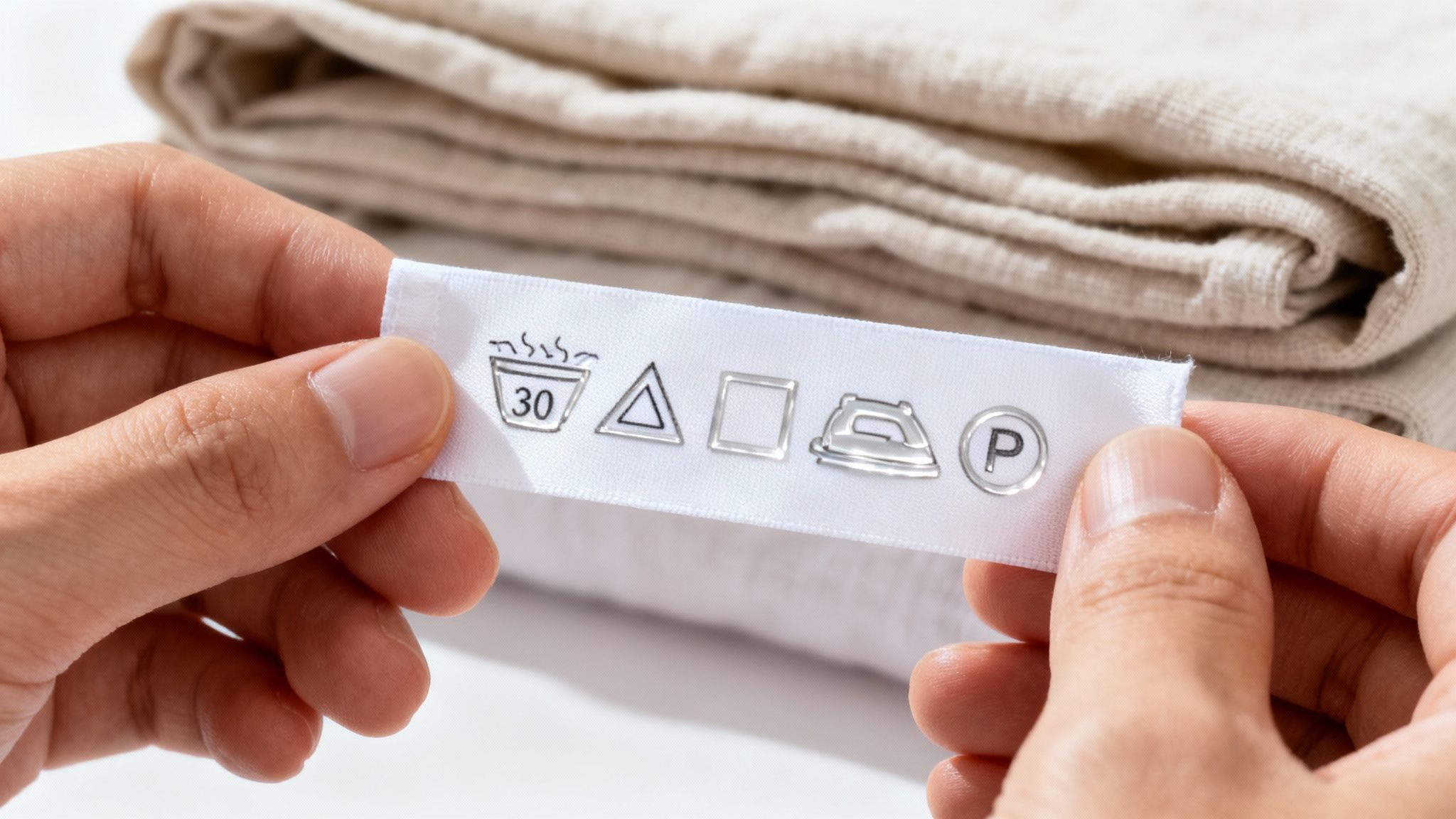
Laundry symbols, or care symbols, are like a universal language through which manufacturers share the most important information with us. Each symbol—from the wash tub to the iron—is a precise instruction on how to care for a particular fabric safely. This is especially important for quality products such as cotton sateen or cotton canvas bedding, whose luxurious feel we want to preserve for as long as possible.
You could say it’s like a baking recipe: if you ignore the recommended temperature or ingredient amounts, the cake will probably fail. The same applies to fabrics—correct instructions guarantee a great result.
What do we lose by ignoring labels?
Every time we wash “by eye,” we risk not only damaging an item, but also suffering financial loss. The main risks are:
- Shrinkage: Water that’s too hot can irreversibly shrink natural fibres such as cotton or wool.
- Colour fading: The wrong wash programme or overly harsh products quickly “wash out” fabric colours.
- Loss of shape: Incorrect spinning or drying can stretch or deform a garment.
- Fabric damage: An iron that’s too hot can literally burn a hole in synthetic fabric.
In this guide, we’ll not only teach you to recognise these symbols, but also explain the logic behind them. That way, you’ll become an expert in caring for your clothes and bedding yourself.
How to decode the main laundry symbols
Take a look at the label on any garment or bedding—you’ll find five main symbols there. It’s like a short, clear “user manual” for your item. These five heroes—washing, bleaching, drying, ironing, and professional cleaning—are universal worldwide, so you’ll understand them anywhere.
Decoding them is much easier than it might seem. Instead of trying to memorise everything, let’s understand the logic. You’ll see that each laundry symbol meaning is quite intuitive.
Washing – the wash tub secrets
The most important and most common symbol is the wash tub. It tells you everything related to washing in water. This symbol has its own internal language—once you learn it, there will be no doubts next to the washing machine.
- Numbers inside (30, 40, 60): These aren’t just numbers—they indicate the maximum allowed water temperature in degrees Celsius. If you see 30, it means you can wash in water no hotter than 30 °C. Simple!
- A hand in the tub: This symbol asks for your personal attention. It means the item should only be hand-washed—gently and carefully, usually in cool water.
- A crossed-out tub: A strict “stop” sign. The fabric must not be washed in water—it requires dry cleaning.
Sometimes you’ll see horizontal lines under the tub. They’re like road signs indicating what level of care and gentleness to choose in the washing machine cycle.
One line under the tub means you should choose a gentler cycle—for example, one intended for synthetics, with slower spinning. Two lines signal an especially gentle programme suitable for delicate fabrics such as wool or silk. If there are no lines, you can safely use the standard cotton programme.
Bleaching – the power of the triangle
The triangle is responsible for bleaching. This is an especially important symbol, because incorrect use of bleach can permanently damage both the colour and the structure of the fabric.
- An empty triangle: Any type of bleach is allowed, including chlorine-based products.
- A triangle with two diagonal lines: Only oxygen-based (chlorine-free) bleach may be used. Be careful!
- A crossed-out triangle: Bleaching is strictly forbidden. No exceptions!
Drying – the rules of the square
The square symbolises all drying methods. Most often, you’ll see a circle inside it—this indicates a tumble dryer.
- A square with a circle inside: Great—you can tumble dry.
- Dots inside the circle: Indicate the heat level. One dot means low temperature, two means medium, and three means high.
- A crossed-out square with a circle: Tumble drying is strictly forbidden.
Sometimes the square may contain other symbols too—for example, a line across the middle that indicates natural line drying.
Ironing and professional cleaning
Finally, the iron and the circle complete the care cycle. The iron symbol works very much like the tumble dryer—dots inside indicate the maximum allowed temperature. One dot means low heat (up to 110 °C), two means medium (up to 150 °C), and three means high (up to 200 °C).
The circle is for professional cleaners. Letters inside it (e.g., P, F, W) are instructions for specialists on what chemicals and cleaning methods to use. If you see a crossed-out circle, it means dry cleaning is prohibited.
By understanding these core principles, you’ll be able to care for any fabric properly. And if you’d like to deepen your knowledge even further, we invite you to explore our guide to the most popular fabric types and their specific characteristics.
To sum everything up and keep it close at hand, we’ve prepared a handy table.
Meanings of washing, drying, and ironing symbols
This table summarises the most common laundry symbols and their variations, so you can quickly find the information you need.
| Symbol category | Symbol (description) | Meaning | When it applies |
|---|---|---|---|
| Washing | Wash tub with a number (e.g., 40) | Wash at the specified temperature (max 40 °C) | Cotton, linen, synthetics |
| Washing | Wash tub with a hand | Hand wash only | Wool, silk, delicate fabrics |
| Washing | Wash tub with 1 line underneath | A gentle wash cycle is required | Synthetics, blended fibres |
| Washing | Wash tub with 2 lines underneath | An extra-gentle cycle is required | Wool, silk, viscose |
| Bleaching | Empty triangle | Any bleach may be used | White, durable fabrics |
| Bleaching | Crossed-out triangle | Do not bleach | Coloured, delicate fabrics |
| Drying | Square with a circle | Tumble drying allowed | Most cotton products |
| Drying | Square with a circle and 1 dot | Tumble dry on low heat | Synthetics, delicate fabrics |
| Drying | Crossed-out square with a circle | Do not tumble dry | Wool, silk, elastane |
| Ironing | Iron with 1 dot | Iron on low heat (up to 110 °C) | Synthetics, nylon, acrylic |
| Ironing | Iron with 2 dots | Iron on medium heat (up to 150 °C) | Wool, polyester |
| Ironing | Iron with 3 dots | Iron on high heat (up to 200 °C) | Cotton, linen |
| Cleaning | Circle | Dry cleaning allowed | Suits, coats, silk |
| Cleaning | Crossed-out circle | Dry cleaning prohibited | Fabrics with special coatings |
We hope this summary helps you navigate more easily and ensures your bedding and clothing last a long time and look impeccable.
How to care for cotton sateen and cotton canvas bedding
All right—we’ve covered the theory, so let’s move on to practice. Let’s talk about the two most popular fabrics that Rustilė uses for bedding: luxurious cotton sateen and sturdy cotton canvas. Although both are 100% cotton, their weave requires slightly different care.
It’s well worth understanding these nuances if you want to enjoy your bedding’s softness and beauty for a long time. Believe us—incorrect washing can quickly turn shiny sateen matte, and make sturdy canvas unpleasantly rough.
Key care tips for cotton sateen
Cotton sateen is loved for its softness and subtle, luxurious sheen, created by a special sateen weave. To preserve these qualities, the most important rule is to treat it gently.
- Temperature: It’s best to choose a lower temperature of 30–40 °C. Hotter water can damage the delicate fibres and gradually “steal” that beautiful sheen.
- Wash cycle: Always use a gentle or delicate wash programme. On the label, under the wash tub symbol, you’ll usually see one line—this is the sign that a gentler cycle is needed.
- Drying: Sateen prefers to dry naturally. If you do use a tumble dryer, be sure to set it to the lowest temperature (one dot in the square-with-circle symbol). Too much heat can weaken the fabric.
Remember: sateen is like silk in the world of cotton. It needs gentle care to keep its regal look. By the way, you can read more about how to tell real cotton sateen from synthetics in our article.
This diagram clearly illustrates the main care stages—washing, drying, and ironing—that matter both for sateen and for canvas.
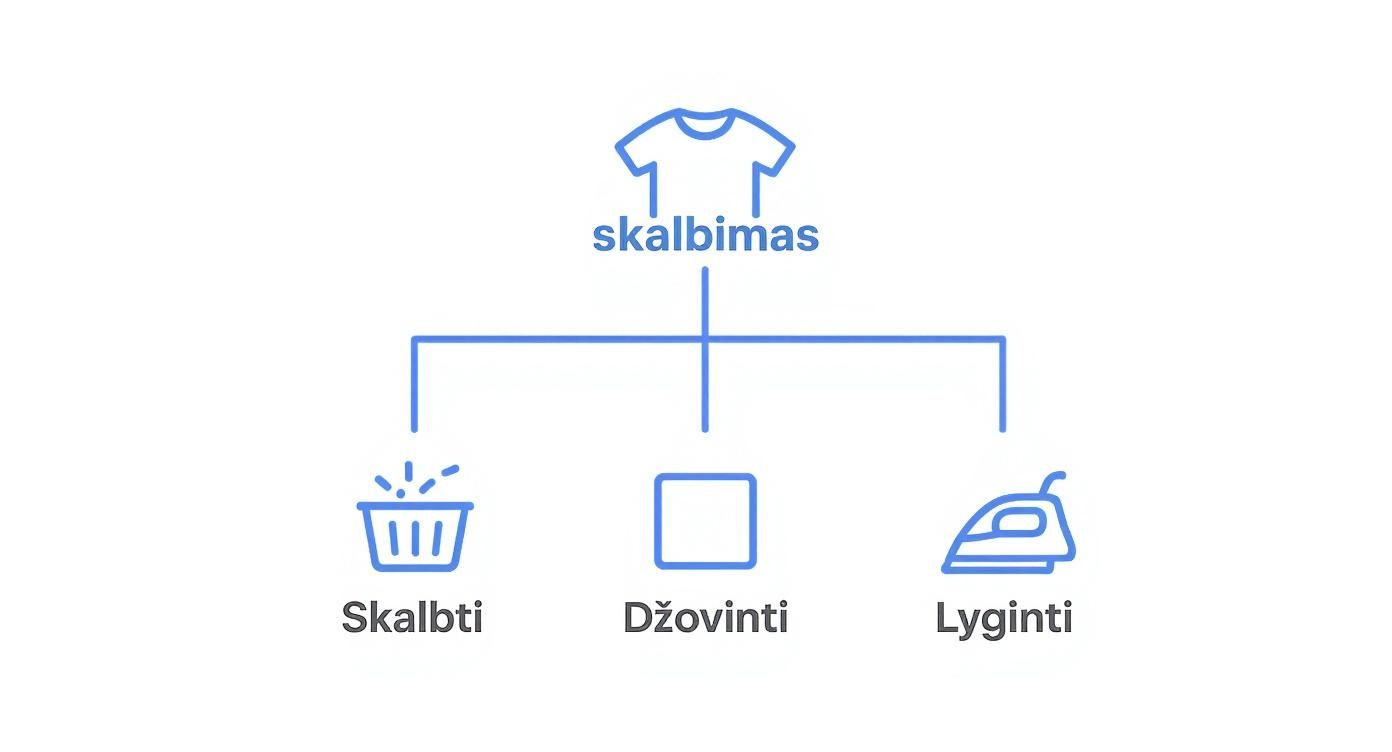
As you can see, each step has its own language of symbols—once you learn it, fabrics will last much longer.
Caring for cotton canvas bedding
Cotton canvas, sometimes called percale, is a densely woven fabric with a plain weave that stands out for its strength and durability. It’s much more resistant than sateen, so caring for it is significantly simpler.
- Temperature: You can confidently wash cotton canvas bedding at a higher temperature of 40–60 °C. This is especially useful when you want to ensure maximum hygiene.
- Wash cycle: A standard cotton cycle works perfectly for canvas. On its label, you’ll usually find no extra lines under the wash tub symbol—meaning the fabric can handle a more intensive wash.
- Drying: This fabric can handle warmer air as well. In a tumble dryer, you can choose medium or even higher heat (two dots in the symbol).
The best part? Properly cared-for canvas becomes softer and more pleasant against the skin with every wash, while retaining its strength and shape for many years. Correctly decoding laundry symbols is the guarantee that your investment in quality bedding will pay off in full.
The most common laundry mistakes—and how to avoid them
Even when you study labels carefully, mistakes can still happen. Most often, it’s not due to lack of knowledge, but simply rushing or being used to doing everything “by eye.” Yet these small, seemingly insignificant inaccuracies gradually shorten the life of your favourite clothing and bedding.
Luckily, most of these mistakes are easy to avoid. You just need to recognise risky habits and replace them with the right actions. Let’s look at a few common scenarios that quietly damage your fabrics—and how to fix them simply.
Mistake No. 1: Overloading the washing machine
One of the biggest temptations is to cram all dirty laundry into the drum at once to save time and water. But an overstuffed machine not only washes less effectively—it also damages the fabrics themselves.
- Poor rinsing: When clothes and bedding are compressed in the drum, water and detergent can’t circulate freely. As a result, fabrics wash unevenly, and detergent residue may remain, irritating the skin.
- Fabric damage: An overloaded drum creates much more friction between textiles. This leads to pilling sooner, and more delicate fibres—such as cotton sateen—wear out faster and lose their softness.
Solution: Always leave about a palm’s width of space between the laundry and the top of the drum. It’s a golden rule that ensures your laundry has enough room to move freely and get properly clean.
Mistake No. 2: Sorting only by colour
Separating whites and colours is a great start, but unfortunately it’s not enough. Sorting by fabric type and “weight” is just as important if you want your bedding and clothing to look impeccable for a long time.
Think of it this way: you wouldn’t cook a thin omelette and a thick steak in the same pan, because they need different temperatures and cooking times. In the same way, you shouldn’t wash heavy jeans together with a delicate silk blouse.
Different fabrics require different wash cycles and water temperatures. Heavy textiles like denim or canvas can mechanically damage lighter, more delicate fabrics such as silk, viscose, or cotton sateen during washing.
Solution: Divide your laundry into several groups, taking into account not only colour, but also the fabric type listed on the label. For example:
- White and light cotton items (cotton canvas bedding, towels).
- Dark and coloured cotton items.
- Synthetic fabrics.
- Delicate fabrics (silk, wool, sateen bedding).
Mistake No. 3: Using too much detergent
It’s often assumed that the more detergent you use, the cleaner your clothes will be. Unfortunately, the truth is the opposite. Too much detergent doesn’t help—it harms both the fabrics and the washing machine itself.
Excess foam prevents fabrics from rubbing properly against each other, so dirt remains trapped in the fibres. On top of that, too much detergent is difficult to rinse out, leaving sticky residues that attract even more dirt.
Solution: Always follow the recommendations on the detergent packaging. If you use a concentrated detergent, you need even less. Also consider your region’s water hardness—soft water requires less detergent than hard water.
Practical tips to extend fabric longevity
Understanding laundry symbol meanings is already half the job, but there are a few more tricks that will help your fabrics last much longer. These are small but very effective habits that protect fibres from damage and help maintain a flawless look.
You could say it’s an extra layer of protection for your favourite clothes and bedding.
Preparation before washing
Before tossing your laundry into the drum, take just a few moments. These steps cost nothing, but the benefits are huge.
-
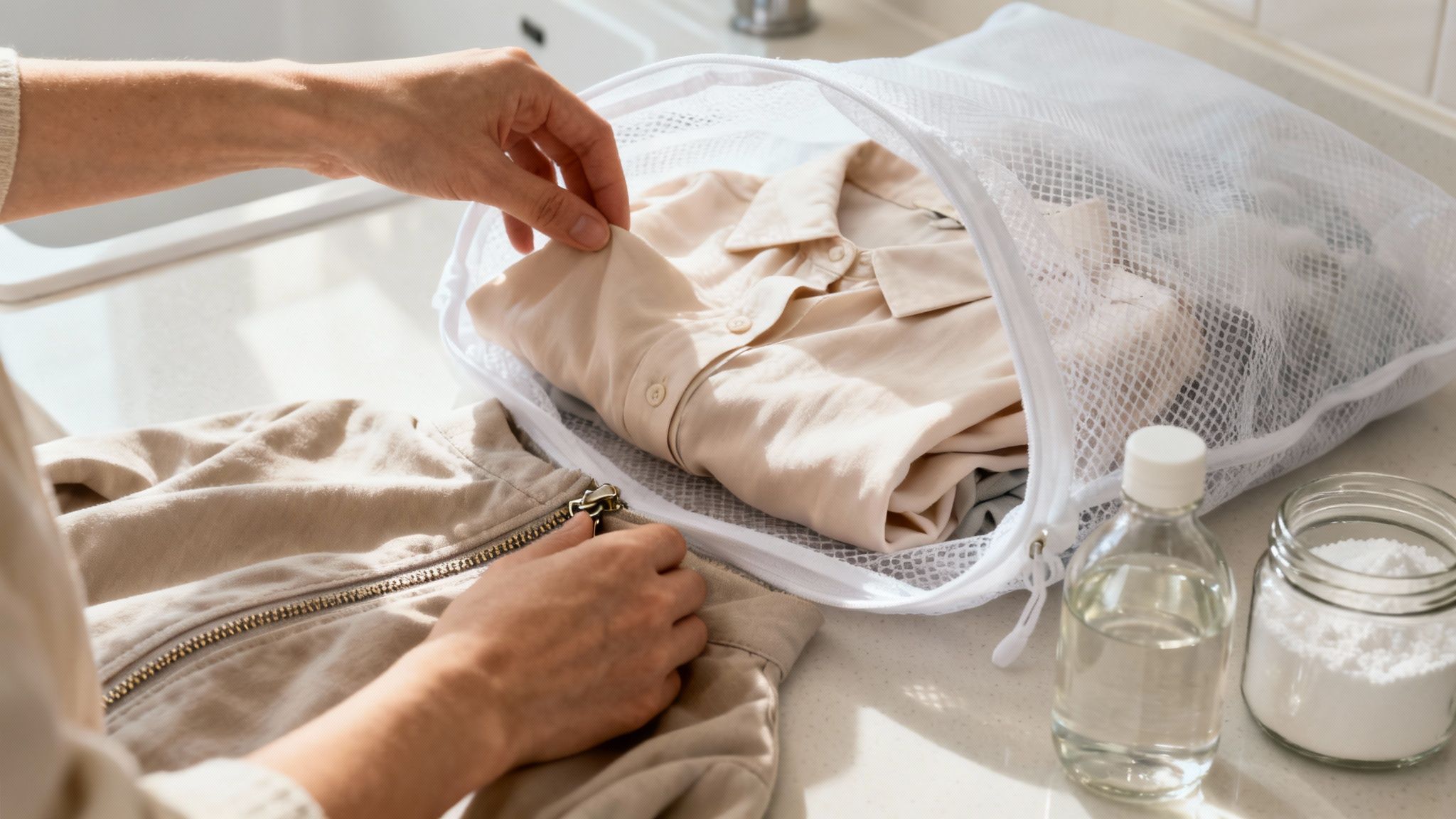
Zip up zippers and fasten buttons. During washing, open metal zippers turn into little weapons—they can scratch, tear, or otherwise damage fabrics spinning next to them. Fastening them protects not only that garment, but everything else in the wash.
-
Turn everything inside out. This rule is especially important for coloured, printed fabrics and patterned bedding. It helps protect colours from fading and the fabric surface from friction and unwanted pilling.
-
Empty pockets. A forgotten coin or a paper tissue can cause plenty of trouble—from fabric damage to clogging the washing machine filter.
Make use of helpful accessories
Sometimes even the gentlest wash cycle isn’t enough. In such cases, special accessories designed to protect the most delicate items come to the rescue.
A special laundry bag is a true lifesaver for delicate fabrics: lingerie, silk, or clothes with beads. It works like a barrier—reducing friction and preventing small details from tangling or breaking off.
Using a bag ensures delicate items are washed safely, retain their shape, and avoid mechanical damage. You can find more tips on caring for quality textiles in our article about Lithuanian bedding and the secrets behind its longevity.
Natural solutions for better results
Sometimes the best solutions are simple, natural products you probably already have in your kitchen. They not only improve washing results, but are also gentler on fabrics and the environment.
-
White vinegar. Pour about half a cup of vinegar into the rinse compartment instead of fabric softener. Vinegar naturally softens fabrics, helps remove unpleasant odours, and rinses out detergent residue—so colours look brighter. Don’t worry: the vinegar smell fully evaporates as it dries.
-
Baking soda. Add half a cup of baking soda directly into the drum with your laundry. Baking soda acts as a natural whitener and deodoriser, helping lift set-in stains and eliminate odours. It also balances the water’s pH, making detergent work more effectively.
By applying these simple yet effective tips, you’ll not only follow label instructions—you’ll also actively contribute to your fabrics’ longevity.
The most common dilemmas—and how to solve them
Even when you know the “alphabet” of symbols perfectly, real life can still bring situations that make you hesitate. That’s why we’ve prepared answers to the most common puzzles, so you can feel confident caring for your fabrics. Let’s take a closer look.
These practical tips will help you make the right choice even when standard instructions seem to be missing. It’s the final step to becoming a true master of fabric care.
What if the clothing label is worn off—or there isn’t one at all?
Sometimes, after many washes, a label becomes unreadable—or worse, it’s missing altogether. In that case, the most important rule is: don’t take risks. It’s better to choose a safer care method than to regret a ruined item later.
Follow these safe steps:
- Always wash in cool water. Choose a temperature of no more than 30 °C.
- Use the gentlest programme. Set your washing machine to a cycle intended for delicate fabrics.
- Forget the tumble dryer. Let the item dry naturally, hanging in the shade.
And if the fabric seems especially delicate—such as silk or wool—it’s best to hand-wash it in cool water or leave the job to professionals.
What does a line under the wash tub symbol mean?
Those lines under the tub are simply indicators of gentleness. They tell you how intensive the wash cycle should be so the fabric isn’t rubbed or stretched too much.
Put simply: the more lines, the more gently you should treat the fabric. One line means gentle washing, and two lines mean an extra-gentle cycle for the most delicate fabrics.
If there are no lines under the wash tub symbol, you can safely use a standard, normal wash cycle.
Can I use bleach if I see an empty triangle on the label?
Yes—an empty triangle is a permissive symbol. It means you can use any type of bleach without fear, including chlorine-based bleach.
However, be careful—the triangle can look different:
- A crossed-out triangle: It is strictly forbidden to use any bleach.
- A triangle with two diagonal lines inside: Only oxygen-based (chlorine-free) bleach is allowed.
Before using any bleaching product, it’s always wise to test it on a small, hidden area of the fabric—so you can be sure you won’t damage the garment.
We hope these tips helped clear up any last doubts. And if you’re looking for bedding that—when cared for properly—will delight you for many years, Rustilė offers handmade products made from 100% cotton sateen and cotton canvas. Discover quality and comfort by visiting https://rustile.de.


